
For software developers
How to price software work when your hourly rate is a guess.
You picked a rate because it sounded reasonable, then quoted a fixed bid on top of it. The build ran long, the design pass got subcontracted, the staging environment kept billing, and the invoice went out at a number decided before any of that was known.
Priscale starts from what an hour of your team actually has to earn, and prices the project up from there.
Fixed bid · rate from a forum thread
- The rate you quoted
- $55.00/h
- What an hour has to earn
- $66.00/h
- On a 92-hour build
- −$1,012.00
Eleven dollars an hour is a thousand dollars a project.
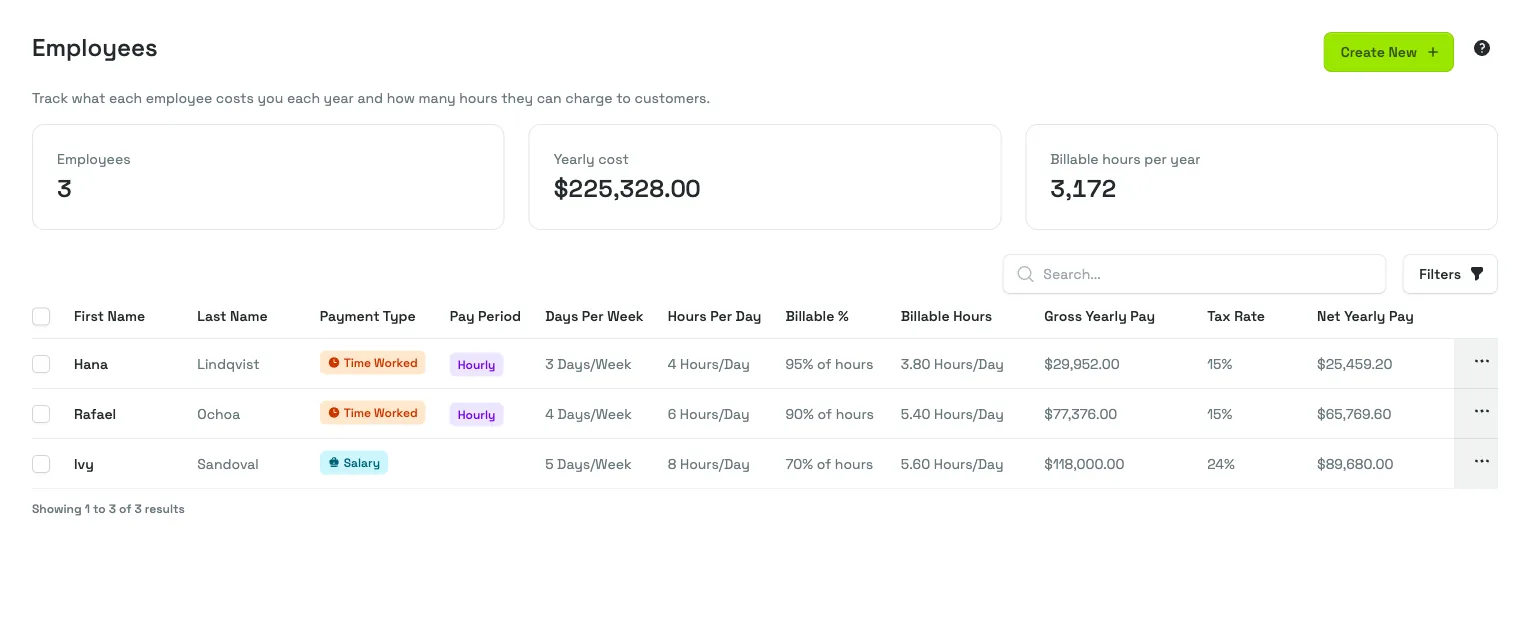
Hourly rate & burn rate
The lowest hourly rate your studio can survive on.
Most developer rates come from a forum thread, a rate calculator somebody posted once, or the number the last client did not argue with. None of those know what your business costs to run, so none of them can tell you when a project is quietly underwater.
Priscale asks for the things you already pay: salaries and your own draw, the laptops, the cloud bill, the error tracker, the design tool nobody remembers subscribing to, the accountant. Then it asks the harder question — how many hours the team can genuinely bill, once standups, sales calls, code review, and the internal work are taken out.
One divided by the other is the minimum viable rate: what an hour has to earn before the studio makes a cent. Quote below it and you are buying the client a discount out of your own pocket.
How the burn rate is calculatedPer year · two developers
- Payroll, software & overhead
- $154,440.00
- Billable hours across the team
- 2,340
- Minimum viable rate
- $66.00/h
Scope as line items
Write the scope down as prices, not as a paragraph.
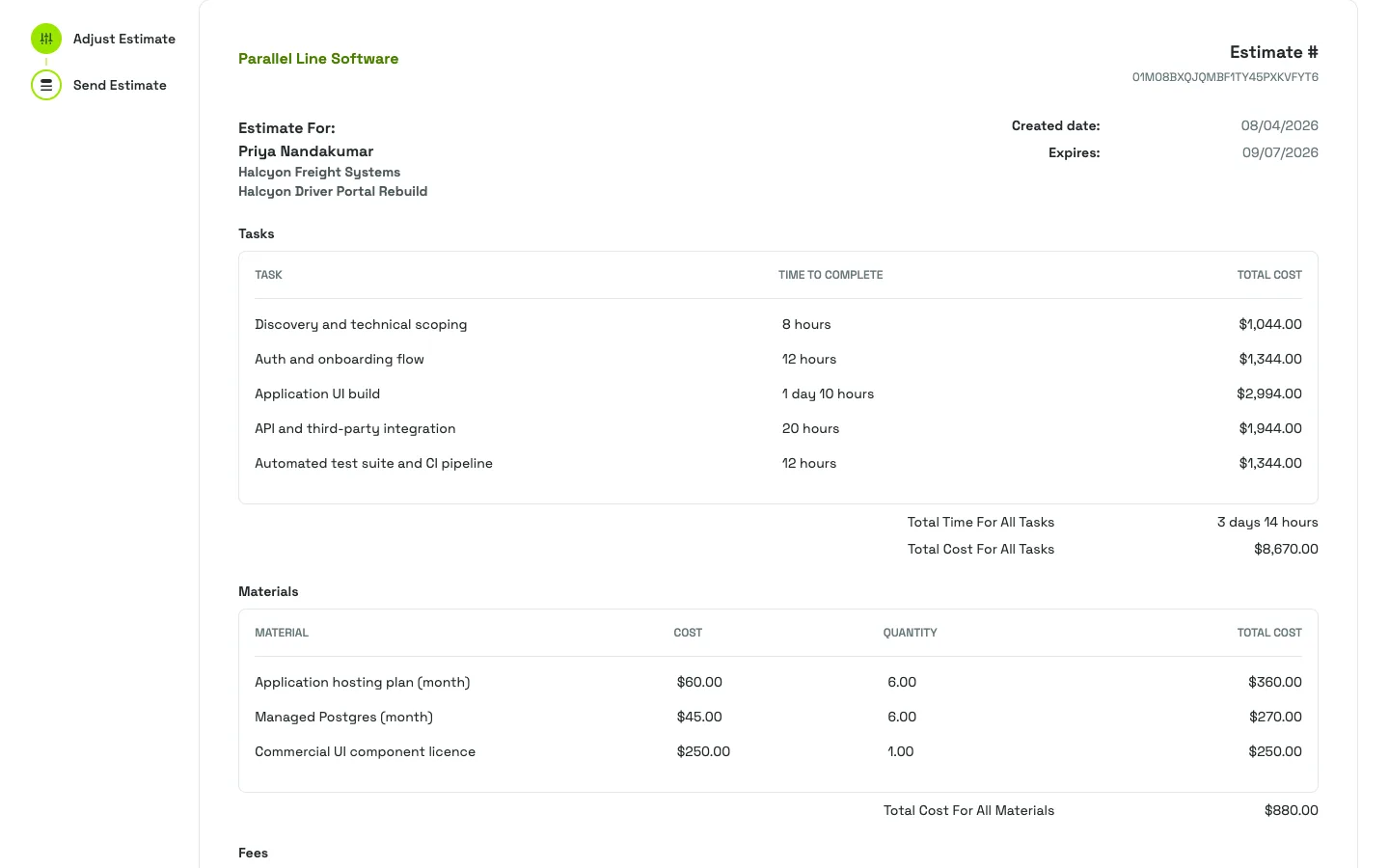
A fixed bid is a scope document with a number stapled to it, and every argument about “that was included, right?” is really an argument about a line that was never written. Priscale builds the estimate out of the work itself: the integration, the migration, the admin screens, the subcontracted design pass, the services and licenses the project runs on, each one priced from your rate or its own cost.
When the client asks for one more screen, you add the line and the total moves in front of them, so scope creep becomes a number instead of an awkward conversation three weeks later. Your profit sits inside the price rather than tacked on at the bottom where it looks negotiable.
More on line-item estimatesClient build · itemized
- Development · 92 h @ $66.00/h
- $6,072.00
- Design & QA subcontract
- $1,400.00
- Services & licenses
- $328.00
- Profit, spread across the lines
- $1,800.00
- Estimate total
- $9,600.00
Send, approve, get paid
Send it to the person who can actually say yes.
Estimates die in inboxes. Priscale sends yours as a secure link, names the approver whose sign-off actually counts, and tells you when the document was first opened, so a follow-up is a decision rather than a guess. Your client never needs an account.
Attach the agreement to the same document, put a payment link at the bottom of it, and export a PDF headed with your studio’s name when procurement asks for one. The moment it is approved you have an approved scope, a price, and a paper trail that matches the estimate you sent.
More on sending and approvalsClient build · sent for review
- Sent for review
- Apr 09
- Opened
- Apr 10
- Approver
- K. Alvarez
- Payment link
- Attached
- Approved
- $9,600.00
Other trades
Not just software developers.
Contractors, landscapers, artists, and anyone else who names a price before the work starts run into the same arithmetic from a different direction.